
Featured

TIPS TO PROTECTING THE INTELLECTUAL PROPERTY IN YOUR BRANDS AND BUSINESSES ON THE SOCIAL MEDIA

image culled from google

Intellectual Property infringement has become constant with the growth of social media. With access to the internet being just a click away, it seems simple and easy to post away, repost or market your brand. However, while the internet has provided almost the perfect platform for sharing your feelings, thoughts or marketing brands and business, it has also provided an almost perfect platform for intellectual property infringing activities, either in the copyright or the trademark.

Businesses are constantly devising new ways to compete on the internet, and this may involve unfair competition practices. Knowingly or unknowingly, products, goods, and services by smaller brands may be passed off as that of a bigger brand on the internet. This may be to derive value or partake in the goodwill that the bigger brand has in the market.  As such, brands may be falsely marketed as being a subsidiary, or an extension of another. In the sphere of social media influencers, their images may be passed off as an endorsement or promotion of a brand. 

These unfair business practices may reduce the market value of a brand, especially when it is associated with what is deemed to be “an inferior brand”.  Passing off a brand as being associated with another may cause confusion in the minds of the consumers since consumers intending to buy one, end up buying the other. This may also reduce the revenue accruing to the more famous brand.

Below are tips to protect the Intellectual Property in your Brands and Businesses on the Social Media

  1. Register your Intellectual Property: The importance of registering your intellectual property cannot be overemphasized. A lot of people take the issue of IP registration as a residual. But the truth is that a Certificate of Trademark Registration confers much more powers than we can imagine. It gives legal protection and cover over the use of your tradename, logo, brand or mark. Registration of your Intellectual Property acts as a warning against anyone seeking to infringe your right over the use of your tradename, logo, brand or mark. Unfortunately, a great populace tends to mistake registration of a Company with the registration of Intellectual Property. Rather they are two different registrations, accord protection to different areas of the law, and also different rights and liabilities. While registration of your company only gives your company a separate legal identity, different from you, registration of your Intellectual Property protects anyone from infringing your right or passing off their brands or products as that of your brand.  
  • Register your presence on Social Media Platforms: More often than not, we mistake the presence of brands and companies on social media as mainly for disseminating information and communicating with their consumers. But having a social media handle protects the Intellectual Property in your brand. This will help to reduce the passing off of fake handles as that of your official company handle. One way that Facebook, Instagram and Twitter had aided brands is by the addition of verification blue tick badge. This helps to create awareness to users on social media and reduce interactions from handles without the blue tick.  Your absence on the internet might provide an opportunity for scrupulous business brands who wish to take advantage of your absence. A check through the various social media platforms will reveal that the world-leading brands in almost all sectors have already registered their presence on almost all social media platforms.  
  • Policing Social Media regularly for infringements: This is arguably one of the most viable means of protecting your Intellectual Property in social media. The law is that “equity aids the vigilant and not the indolent”. The fact that you have registered your Intellectual Property does not mean you should fold your arms. As a brand owner, the duty of policing the streets of the internet to monitor and catch infringement of your IP is on you. You have to be vigilant, as constantly, as new means of using IPs without obtaining the requisite licenses are constantly evolving. 
  • Disclaimers: IP owners have the duty of constantly putting out disclaimers as once an infringing brand or product is encountered. Putting out disclaimers as early as possible may help to reduce the quantum of damage an infringing act has on a brand. 
  • Legal Action: Sometimes, smaller brands that are yet to register their presence in the market may be dissuaded from pursuing legal action because of the cost associated with it. While it is always advised to weigh the financial implication of pursuing legal action, the effect of not taking any action should also be weighed. The possibility that this might create a bad precedent for your brand, leading to an increasing number of brands infringing on your Intellectual Property, with the belief that you will not pursue your right in Court. Failure to take up a legal action might be summarised to mean implied consent, which may actually not so. In that situation, you cannot later turn around to sue, as, by your action, you are deemed to have acquiesced to the infringement. 
  • Negotiating a Licence: This is an alternative to legal action, especially where your Intellectual Property Portfolio in a brand is large, that you cannot effectively monitor the use of your IPRs and efficiently police the market. When there is an infringement, instead of taking an action in court, the brand can negotiate a license in exchange for royalties. In such a situation, the duty of monitoring and policing the market falls upon the Licencees, who are therefore to take care to ensure that they are the only users of the Intellectual Property in the market. 

Image culled from Google

Top Legal tips for Startups

You have an inspiring and innovative idea and you believe that it can change the world. No one can convince you otherwise. So you invest your time and resources in developing your idea and building it up to a startup model. With the right legal guidance, you could be the next big thing after jollof rice. Here are the top tips you should be concerned with as you proceed on your startup journey.

  1. Never, ever think that getting a lawyer is an unnecessary expenses. A lot more startups has failed than succeeded with this ideology.
  2. Business Structure- Get the the right business structure. As a startup, you must be thinking long term goal. So whatever business structure you decide on, the long terms effects to your company should be on your mind. You can decide to incorporate a Company, register a business name or an LLP. Whichever business structure you decide on, please note that each has its own legal implication.
  3. Funding Sources – How do you want to fund start up? From personal savings, from loans or investors? The legal risks associated with funding sources from personal loans and savings are much more lower than that associated with funding from loans and investors.
  4. Legal Compliance (Licenses, permits and certifications)- Depending on your industry, ensure you are regulatory and statutorily complaint. There are different licenses, permits and certifications you are required to have before you can commence your start up. Please make sure you acquire all the required licenses, permits, certifications and comply with the required regulatory and statutory requirements required within your territory.
  5. Contracts – This tip cannot be over emphasized. Never conclude you business deals only on the faith of a handshake. Have that contract signed. Be it your shareholders Agreement, Founders Agreement, Non-Disclosure and Confidentiality, Employees Contract, Licensing and Franchise Agreement. There is nothing more confidential that an iron-clad agreement. Never rely on the standard contracts found online. Get a lawyer to draft one for you.
  6. Intellectual Property – As a fresh startup, you are probably filled with innovative ideas and concepts. These concepts can be copied and replicated by another start up. You need to protect the Intellectual Property in your startup by registering your logos, trademarks, patents, protecting your business models, software programing, development. Where required, make sure your IPRs are protected. In the absence of a proper protection, you are at risk of Intellectual property theft, and you may even assign your IPRs unknowingly.
  7. Taxes – Know your tax obligations and pay your taxes as and when due.

Finally, get a Lawyer before you commence your startup. Walk hand in hand with your lawyer through every stage of your startup. Your will avoid unnecessary legal deadlocks.

image culled from google

Non-Compete Contract: Valid and Enforceable?

One of the terms in our various contracts of employment is the non-compete Clause. What exactly is a non-compete clause?

A non-compete clause is a clause in a contract that restrains you from working for your employer’s competitor in the future. It is also known as a “contract in restraint of trade”. 

In most contracts of employment, you see clauses like:

The employer expressly agrees that, at all times during his employment with XYZ Limited and for a period of XYZ years immediately following the termination of this contract, he will not directly or indirectly engage in or own or operate a part or all of any business that is competitive with XYZ limited or any of its affiliates pursuant to his employment under this Agreement or any extension thereof.

So are non-compete clauses, like this above valid and enforceable?

Nigerian Courts are not always favorable to blanket non-compete clauses. The argument is because it is purely against public policy to restrain you from using your skill and knowledge acquired by virtue of your education, experience and intelligence to advance your career. This means that most standard and seemingly iron clad non-compete clauses like that above will not see the light of the day in court and will be considered invalid. This is so, even if the employee has signed the Contract before the resumption of employment.

So how do you make a standard non-compete enforceable.

First, it must be supported by a consideration. I mean, it makes sense that if you want to restrain an employee from using his knowledge, skill and expertise, it must be for a consideration. You must put a value to that restraint. How then is he to survive and fend for himself?

It must be reasonable with regards to duration and geographical limitation. Again, you can’t restrain an employee from working for a competitor forever, worldwide, or even within Nigeria.

There must be a legitimate business interest to protect. More like restraining someone with knowledge of your trade secrets from working for a competitor.

Finally, please consult your Lawyer to properly guide you on how to draft a comprehensive non-compete that will stand the test of validity and enforceability.

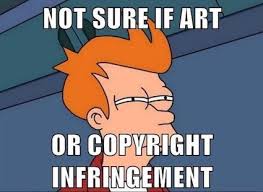
WHO OWNS THE COPYRIGHT IN A MEME

Image culled from Google

According to Merriam-Webster Dictionary, a meme is an idea, behavior, style, or usage that spreads from person to person within a culture, originating in the same root as imitation.

Memes is a Literary work eligible for copyright protection under Section 1(1) of the Copyright Act.  It can also be in the form of a cinematograph film and photographs, all protected under Section 1(1) of the Copyright Act.

With popular culture, memes became one of the most important means of communication, via internet, attracting likes and viewership. By the nature of social media, memes adds value to a social media account by generating likes, followership and views. Content creators on social media, who create a meme, and whose memes become viral are faced with the option of protecting their intellectual work to prevent it from being shared without their consent.

Under Section 15(1) of the Copyright Act, the rights of a copyright owner will be deemed to be infringed by any person who, without the licence of authorization of the owner of the copyright, does or causes any person to do an act, the doing of which is controlled by copyright. Therefore exercising any of the rights reserved for the copyright owner results in an infringement of copyright. These rights include the right to reproduce, publish, perform, translate, distribute, broadcast, make into a cinematograph film or an adaptation. They are protected under Section 6 of the Copyright Act.

The Second schedule to the Copyright Act list the exceptions from copyright control, to include the doing of any acts stated under the section by way of fair dealing, use for parody, pastiche or caricature, etc.

While the creator of a meme may enjoy the copyright associated with the meme, subsequent users may enjoy fair use on the use of the meme in the internet without the authorization of the copyright owner. Here is why:

When a meme becomes viral on the internet, reposting same by other social media users is fair use. This is largely because the meme may have been reposted for caricature, comedy or parody, which is protected under the Second Schedule of the Copyright Act. In addition, the reposting may not add value to the accounts reposting same.

Fortunately, everything is not fair game on the internet. As such, the situation may be different when the reposting is done with the intent to monetize. In the instance where it adds some value to the account that it reposts same, or is used in advertisement, marketing and commercial purposes, it transcends the fair use doctrine, and becomes a commercialization of copyright that requires a licence.

Social media users with a large number of followers, who make their livelihood off the social media should however remember that copyright laws apply on the social media the same way it applies to other fields. Large Corporations with vast social media followers should ensure that they obtain the required copyright license before they repost a meme because of the huge possibility that the reposting may be seen as attempted commercialization.   

Design a site like this with WordPress.com
Get started